





Welcome to the Support section of the Nextek Power Systems site. This section includes an extensive list of Frequently Asked Questions, and file libraries for Spec Sheets, Installation and Operation Manuals, Technical Documents and downloads of software updates. You can also contact our Support Team for specific equipment and software issues.
General Design / Implementation / Construction
- Why should we consider implementing a DC Microgrid?
- What available products operate on DC voltage?
- What is the cost of these DC products compared to their AC equivalents?
- How can we integrate multiple DC sources, (solar / wind / battery / converted AC) into a unified, usable DC power supply?
- What AC light fixtures compatible with the Nextek DC Ballasts?
- Can AC powered fluorescent and CFL fixtures be converted to DC by just swapping out the ballast from AC to DC?
- Can DC fixtures be wired together in a single run, or do they need to be wired in dedicated runs back to the DC source (PSM Unit)?
- Are PSM Units, or similar DC source / control units, required to power DC lighting, or are there other ways to connect DC fixtures to a DC power source?
- Can PSM units be connected to 120 VAC power?
- How can we coordinate various DC components from different manufacturers into a complete system? Are there resources to guide us?
- Are there unified CSI formatted specifications available for all products?
- Is UL or similar listing required for all DC components, or just some? How can I find the status of UL approvals?
- Are DC Microgrid system designs covered by the NEC?
- Do licensed electricians need to wire and install the 24vdc components and fixtures, or can General Trades personnel do that work?
- Is there a separate color standard for DC wiring so that it does not become confused with AC wiring?
- What type of lighting controls can I use with a DC EMerge Alliance® System?
- What type of connectors can I use with a DC EMerge Alliance® System?
- How long are the 24 VDC cables that deliver power to the DC devices or an Energized Ceiling Grid?
- Can I get a LEED credit for using an EMerge Alliance® Standard based system on my project?
- Does a DC Microgrid based system work in a residential application?
- Is a DC Microgrid system more efficient than using an inverter based DC to AC system?
- Will I have to rewire my building to incorporate a DC system?
- Do I need to replace light switches with DC rated switches?
- Can Nextek ballasts run on AC and DC power?
- Does a DC Microgrid system require batteries?
- Do DC Microgrid systems qualify for rebates or credits?
Operational
- What happens if the Power Supply Module (PSM) loses power?
- What causes a Power Supply Module (PSM) to experience a fault condition?
- What conditions cause an under/over voltage fault?
- What conditions cause a PSM overload fault on an Armstrong DC FlexZoneTM Grid System?
- What conditions cause a short circuit fault on an Armstrong DC FlexZoneTM Main Beam?
- What conditions cause a temperature fault?
Theoretical / Reference
- Why do I not get shocked when I touch 24 VDC but still get shocked when I touch 120 VAC?
- Is there danger when Low Voltage cabling gets wet?
- Concerning Electromagnetic Interference from a health perspective, is there any difference using 120 VAC or 24 VDC?
- What is the EMerge Alliance®?
- Where do I find EMerge Alliance® registered products?
General Design / Implementation / Construction
Why should we consider implementing a DC Microgrid?
The functions and component features of a DC Microgrid solution are designed to reduce energy use as compared to consumption from the AC grid. The more extensive the system, the greater the energy savings, resulting in cost savings and a reduced carbon footprint. In many cases, these cost savings can be significant. A Nextek Power Systems representative can help you determine just how much your company could save by switching to DC. Back to top
What available products operate on DC voltage?
The list of products configured to operate on 24 VDC voltage continues to grow. Since any electronic device that uses semiconductors requires DC power, the potential exists for thousands of products to be made DC-ready. Refer to the DC Power Distribution and Device Discussion section of this Design Guide for additional information. Back to top
What is the cost of these DC products compared to their AC equivalents?
The cost of DC components (luminaires, wiring, controls, devices) is comparable to their AC equivalents, and in most cases they are the same device with only the power input circuitry altered to operate on DC power. Certain DC devices may also be less expensive because they do not need an internal AC to DC converter. Back to top
How can we integrate multiple DC sources, (solar / wind / battery / converted AC) into a unified, usable DC power supply?
The process of developing a complete DC Microgrid solution is grounded in common Electrical Engineering principles and can therefore be performed by a variety of resources. As an industry innovator and leader in the development of engineered power solutions, Nextek Power Systems personnel are trained in helping you efficiently combine power from a variety of sources into a unified DC Microgrid power supply. Back to top
What AC light fixtures are compatible with Nextek DC Ballasts?
Most AC fluorescent lighting fixtures are compatible with the Nextek DC Ballasts. Many manufacturers now produce factory assembled fixtures that include Nextek DC Ballasts, which require only a simple retrofit procedure. For an up-to-date listing of these fixtures, refer to the registered products section at www.emergealliance.org or contact your Nextek representative. Back to top
Can AC powered fluorescent and CFL fixtures be converted to DC by just swapping out the ballast from AC to DC?
In most cases, existing, popular style AC fluorescent luminaires can accept a replacement Nextek DC Ballast. Each luminaire needs to be assessed to determine its compatibility. The AC wiring to existing luminaires would most likely need to be replaced with new wiring designed to connect with the Nextek PSM unit. A Nextek Retrofit Kit for 1-Lamp, 2-Lamp and CFL Ballasts is an easy-to-install conversion product. Note that in this potential application, the modified product would not be UL listed or EMerge Alliance® Registered. Back to top
Can DC fixtures be wired together in a single run, or do they need to be wired in dedicated runs back to the DC source (PSM Unit)?
The wiring of DC light fixtures will depend on making sure that the combined wattage does not exceed the available power of the source channel or circuit. For EMerge Alliance® Standard System applications, as powered by the Nextek PSM unit, each channel can supply 95 watts. This could accommodate multiple lower wattage fixtures in a daisy chain arrangement, which is then connected to the PSM channel. For luminaires that each exceed 47 watts, they would require a dedicated channel. Back to top
Are PSM units, or similar DC source / control units, required to power DC lighting, or are there other ways to connect DC fixtures to a DC power source?
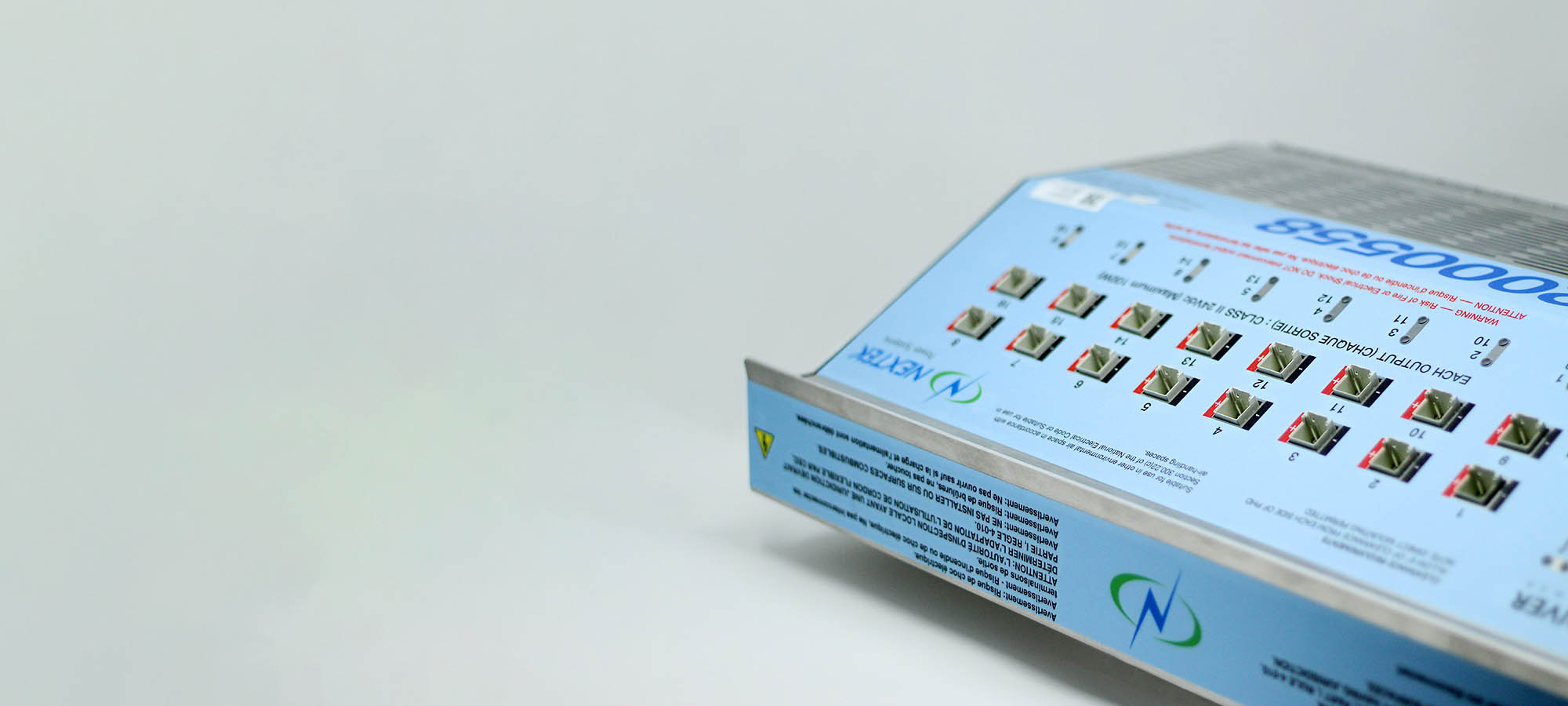
The Nextek PSM unit is the only EMerge Alliance® Registered device that is available to power 24 VDC fixtures and devices as defined in the EMerge Alliance® System. Back to top
Can PSM units be connected to 120 VAC power?
It is recommended that PSM units be connected to at least 208 VAC power. See the PSM product page for exact specifications. Back to top
How can we coordinate various DC components from different manufacturers into a complete system? Are there resources to guide us?
The EMerge Alliance® and its members offer convenient access to and provide reference for other participating member product data through their websites. In addition, Nextek Power Systems offers consultation services to assist with system design and DC product selection. Back to top
Are there unified CSI formatted specifications available for all products?
There are CSI format specifications provided within this Design Guide, (and available in editable .doc format at our design professionals page, that pertain to certain Nextek products. Additional specification development information is available upon request or from other EMerge Alliance® members that offer registered products. Back to top
Is UL or similar listing required for all DC components, or just some? How can I find the status of UL approvals?
It is the intent that all EMerge Alliance® Registered products are or shall be UL listed or made of UL listed components. Consult with EMerge Alliance® company representatives directly for specific UL status regarding specific products. Back to top
Are DC Microgrid system designs covered by the NEC?
Components, wiring and overall system design and function for a DC Microgrid system are in the voltage range of the systems as defined by the NEC. Back to top
Do licensed electricians need to wire and install the 24 VDC components and fixtures, or can General Trades personnel do that work?
It is recommended that licensed electricians perform all initial wiring work. Back to top
Is there a separate color standard for DC wiring so that it does not become confused with AC wiring?
At this point, there is no specific color standard or wire markings for DC systems. It is recommended that DC wiring and devices have some form of identification different from similar AC components. Back to top
What type of lighting controls can I use with a DC EMerge Alliance® System?
Any EMerge Alliance® registered control device can be used. Back to top
What type of connectors can I use with a DC EMerge Alliance® System?
Any EMerge Alliance® registered connector can be used. Back to top
How long are the 24 VDC cables that deliver power to the DC devices or an Energized Ceiling Grid?
The length of low voltage cables that connect power to the DC devices or an Energized Ceiling Grid are defined within the EMerge Alliance® Standard as follows: Power Cable Assemblies should not exceed the lengths noted in the table below for circuits that are designed to carry full load currents. Circuits dedicated to sensors, user controls, and other low-power devices may exceed these limits. Back to top
| Gauge(AWG) | Max Length (ft) |
|---|---|
| 12 | 30 |
| 14 |
25 |
| 16 |
15 |
| 18 |
10 |
Can I get a LEED credit for using an EMerge Alliance® Standard based system on my project?
Possibly. You can apply for a LEED innovation credit for using EMerge Alliance® registered products in an overall reduced energy use solution. Using EMerge Alliance® registered products may help lower your energy usage, which may also help you achieve the criteria for other LEED credits. Back to top
Does a DC Microgrid based system work in a residential application?
Yes. The efficient use of DC powered devices is applicable for any building. Due to the generally greater power demanded from commercial building occupancy loads, the use of DC Microgrid technology is generally better suited for commercial applications. But use within a residential application can still be significantly beneficial. Back to top
Is a DC Microgrid system more efficient than using an inverter based DC to AC system?
Yes, very much so. By elimination of an inverter based system DC to AC system, direct use of DC power can produce an increase in overall system efficiency of generally between 20% and 40%. Many factors of an overall system design will ultimately define the specific efficiency gain when compared to a DC to AC inverter based system. Back to top
Will I have to rewire my building to incorporate a DC system?
In general, the DC loads supplied in a DC Microgrid designed system are connected using same or similar wire sizes as comparable AC loads. As such, for certain applications, use of existing AC wiring may be possible. For new 24 VDC, Class 2 wiring solutions, generally new wiring will be required to facilitate connections to the Nextek PSM unit. Note that these Class 2 cables are more easily installed than conventional AC wiring because they do not need to be in conduit. Back to top
Do I need to replace light switches with DC rated switches?
In an EMerge Alliance® based system, the lighting is powered from the Nextek PSM unit. The on, off or dimming control of light fixtures are achieved with new DC powered controls, many of which are wireless. As such, use of existing, limited AC light switches is not practical or necessary. Back to top
Can Nextek ballasts run on AC and DC power?
No. The Nextek ballasts for EMerge Alliance® based systems can only be connected to 24 VDC power. Back to top
Does a DC Microgrid system require batteries?
No. DC storage batteries are optional for a DC Microgrid system. A properly designed DC Microgrid will have redundant power sources from both organic DC and rectified AC sources to maintain power to the system. Without batteries, during a power failure, the system will still function providing that the DC power sources are generating power. Back to top
Do DC Microgrid systems qualify for rebates or credits?
Yes. There are many forms of tax credits, rebates and other financial incentives in the marketplace to support the purchase and implementation of DC Microgrid systems or components. Each system will qualify for a unique array of local and Federal financial incentives based on configuration and location. Specific incentives are constantly changing. Back to top
Operational
What happens if the Power Supply Module (PSM) loses power?
If you lose power to a Power Supply Module all of the electrical devices connected to the Armstrong DC FlexZoneTM main beams being supplied from that PSM will also lose power. However, when power is restored to that PSM, power will be restored to the Armstrong DC FlexZoneTM grid and its connected devices. The devices will generally reset to the state at which they were when power was lost. Back to top
What causes a Power Supply Module (PSM) to experience a fault condition?
The Power Server Module protects against over and under voltage, overload, short circuit, and over temperature and will experience a fault if any of these condition occur. Back to top
What conditions cause an under/over voltage fault?
EMerge Alliance® compatible devices shall operate with a nominal input voltage of 24 VDC and shall be tolerant of 24 VDC nominal +2%, -5% per last Standard update. This equates to an operating range between 24.5 VDC to 22.8 VDC. An under/over voltage fault will occur if the voltage is outside of this allowable range. An over voltage condition will cause the Power Supply Module to lock out and require a reset. Back to top
What conditions cause a PSM overload fault on an Armstrong DC FlexZoneTM Grid System?
An overload fault will occur when an Armstrong DC FlexZoneTM main beam is supplied with more than 95 Volt-Amperes (Watts) of power. The PSM will sense this overload fault and stop delivering power to this associated main beam. The PSM will continue to deliver power to the other Armstrong DC FlexZoneTM main beams that are not experiencing an overload fault. When the Armstrong DC FlexZoneTM main beam overload fault is corrected, the power supply module will automatically reset and deliver power to this main beam. Back to top
What conditions cause a short circuit fault on an Armstrong DC FlexZoneTM Main Beam?
In electrical devices, unintentional short circuits are usually caused when two wires come in contact with each other, or when another conducting material such as water, or a piece of metal is introduced, allowing the electrical current to flow along a different path besides the one intended. A short circuit fault can occur when an unapproved wire or clamp is placed around the Armstong DC FlexZoneTM main beam and incidentally touches both conductors at the same time. A screw placed through the electrical conductors on the bulb of the grid for support will cause a short circuit fault. The Power Supply Module will sense this short circuit fault and stop delivering power to this main beam. The PSM will continue to deliver power to the other Armstrong DC FlexZoneTM main beams which are not experiencing a short circuit fault. When the Armstrong DC FlexZoneTM main beam short circuit fault is corrected the PSM will automatically reset and deliver power to this main beam. Back to top
What conditions cause a temperature fault?
EMerge Alliance® compatible devices shall operate between the range of 0° and 50° C. A temperature fault may occur if the operating temperature is outside of this range. The power supply module will sense this temperature fault and stop delivering power to the system. When the temperature becomes restored to an acceptable range, the power supply module will again deliver power back to the system. Back to top
Theoretical / Reference
Why do I not get shocked when I touch 24 VDC, but still get shocked when I touch 120 VAC?
24 VDC is not a high enough voltage to cause pain in most people. 120 VAC does cause pain and burn skin because of the higher voltage and the fact that it is cycled—that is, the 60 Hertz frequency means you are actually being shocked 60 times every second. Back to top
Is there danger when Low Voltage cabling gets wet?
No, low voltage cables are UL listed and are rated to survive a wet event. However, they are not intended to operate in an underwater condition. Back to top
Concerning Electromagnetic Interference from a health perspective, is there any difference using 120 VAC or 24 VDC?
Electromagnetic Interference occurs when an electrical device is affected by the electromagnetic radiation emitted from a different electrical device. Such low frequency or narrowband interference usually arises from frequency transmissions in radio, television stations, pagers and cell phones. This type of interference has not been shown to pose a health hazard in humans. High frequency or broadband interference, which can be hazardous, usually comes from frequency transmissions from high voltage electric power transmission lines and electric motors. Since DC powered devices do not operate at a frequency like AC power, the health hazard is inherently lower. Back to top
The EMerge Alliance is an open, membership-based, not-for-profit industry association formed in 2008 to create and promote the adoption of new standards for Direct Current (DC) power distribution within commercial buildings to improve their flexibility and sustainability. Visit the EMerge Alliance® website at: www.EMergeAlliance.org. Back to top
Where do I find EMerge Alliance® registered products?
EMerge Alliance® registered products can be found at: www.emergealliance.org/Products/RegisteredProducts. Back to top